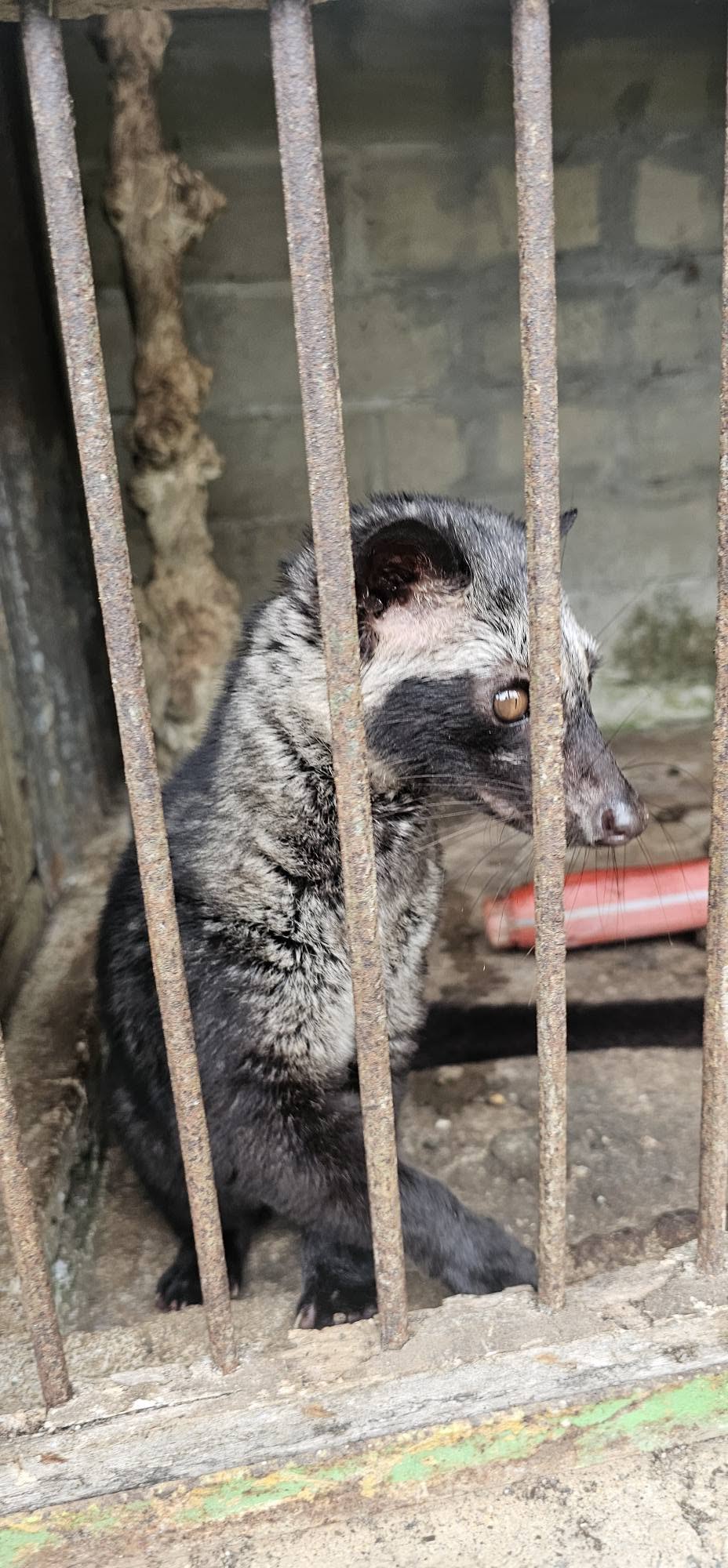
I had heard of kopi luwak, the expensive coffee made from beans that have passed through a civet. But seeing the process during a recent visit was confronting.
There was the familiar promise of a premium product: coffee prepared for visitors, packets ready to take home, and a story that turns an unusual production method into a luxury experience. Then there was the animal behind it.
A civet behind bars.
That contrast stayed with me. The packaging invites us to think about rarity, flavour and exclusivity. The cage asks a much harder question: what are we willing to accept for a cup of coffee?
My recommendation is simple: do not buy or drink civet coffee. Choose coffee that does not depend on keeping wild animals for our consumption or entertainment.
A civet behind bars, photographed during my visit. Photograph: Charuka Abhayawickrama.
What is kopi luwak, and how is civet coffee made?
Kopi luwak is coffee made using beans recovered from civet droppings. A civet eats ripe coffee cherries, the fruit passes through its digestive system, and the beans are excreted. They are then collected, cleaned, processed and roasted before being brewed.
It is sometimes marketed as “cat poop coffee”, although civets are not domestic cats. The unusual journey of the beans is central to the sales pitch. For me, however, the problem is not that the beans have passed through an animal. It is what can happen to that animal so that the product remains available.
Traditional production involved collecting droppings from free-ranging civets. Keeping civets in captivity to supply beans or attract tourists is a different practice, with very different welfare consequences. Research published in Animal Welfare in 2016 makes that distinction explicit.
Why is civet coffee associated with animal cruelty?
The concern extends beyond an uncomfortable photograph. Researchers and animal welfare organisations have documented serious problems in parts of the industry, including wild capture, restrictive cages, inadequate diets and limited opportunities for natural behaviour.
The 2016 study assessed 48 wild-caught common palm civets at 16 tourist-oriented coffee plantations in Bali. It examined factors including movement, shelter, food, water and hygiene, and reported inadequate conditions associated with captive commercial production. These findings describe the facilities studied; they are not a count of every producer.
A further study, published online in 2023 and in a 2024 journal issue, surveyed 29 civet coffee tourism plantations in Bali during 2018. Researchers recorded 99 civets there and reported that none of the assessed plantation civets met all five welfare freedoms. Poor diet, restricted movement and limited opportunities to hide were among the problems identified.
Those studies do not establish the conditions at every operation today. They do establish that the welfare concerns are documented and deserve scrutiny before anyone treats a tasting as harmless holiday entertainment.
Capture and confinement
World Animal Protection describes civets being captured with traps, snares and hunting dogs to supply the trade. It reports injuries, stressful handling and confinement in small, bare cages, sometimes without adequate shelter or bedding.
A wild animal has needs that a product label cannot convey. Being alive and available for visitors to see is a very low standard by which to judge its wellbeing. We should be asking whether it has meaningful choices: room to move, somewhere to retreat, and freedom from unwanted human attention.
Diet and daily welfare
Civets are omnivorous. A diet built around producing coffee beans does not necessarily meet their nutritional needs. The 2024 paper describes inadequate dietary variety and highlights the importance of suitable food, water, hygiene and space.
World Animal Protection also reports repetitive pacing and self-harming behaviour in captive civets. A visitor cannot diagnose an animal from a brief encounter. Equally, an animal sitting quietly should not automatically be taken as evidence that it is content.
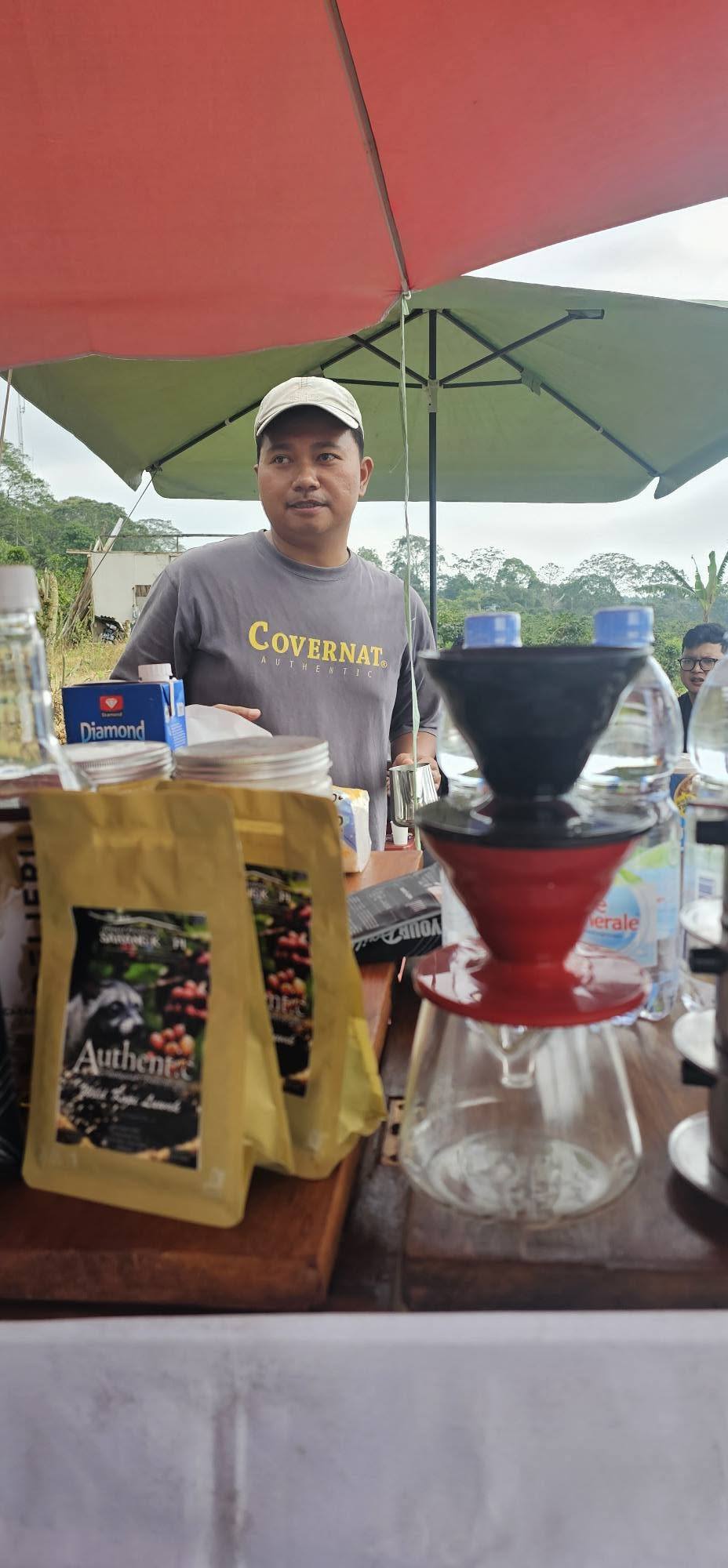
The retail side of the experience: packaged coffee and brewing equipment. Luxury presentation tells us little about animal welfare. Photograph: Charuka Abhayawickrama.
Is wild-sourced or cage-free kopi luwak ethical?
There is a real distinction between collecting beans left by free-ranging civets and confining animals to produce or promote coffee. World Animal Protection has supported genuinely wild-sourced, cage-free production as an alternative to captive production.
That distinction matters. It would be misleading to say that every bean sold as kopi luwak necessarily came from a caged animal.
But a claim on a packet is not the same as evidence about its supply chain. As a buyer, I would want independently verifiable information about where the beans came from and whether any captive civets were involved. A pleasant setting, a reassuring explanation or the word “natural” would not answer those questions.
My personal choice is to avoid civet coffee altogether. I do not need it, and there are countless ways to enjoy coffee without navigating uncertainty about the treatment of a wild animal.
How coffee tourism can keep the trade going
A visitor may think a single cup makes little difference. Yet purchases, tasting fees and recommendations tell businesses what people will pay to experience. When the animal becomes part of the attraction, demand can extend beyond the beans themselves.
I believe responsible travel means looking beyond what is offered to us. A stop described as a plantation visit or local tradition still deserves questions about how animals are kept and why they are there.
This is not a reason to reject local communities or coffee tourism. It is a reason to direct our spending towards farmers, roasters and guides whose work does not rely on captive wildlife. We can appreciate coffee growing, roasting and brewing without asking an animal to become part of the performance.
What travellers and coffee drinkers can do
-
Decline civet coffee. Skip the tasting and souvenir packet, and explain calmly that animal welfare is the reason.
-
Ask before booking. Find out whether a coffee tour keeps civets or includes animal handling. Choose a visit centred on coffee cultivation and people’s skills.
-
Avoid wildlife photo opportunities. Do not pay to hold, pose with or disturb a civet.
-
Support other coffee producers. Ask about bean origins, farming practices and how growers are paid.
-
Share accurate information. Describe what you actually observed and distinguish it from research about the wider industry.
-
Raise concerns responsibly. If you witness suspected mistreatment, document it safely and contact an appropriate animal welfare organisation or local authority. Do not attempt to release an animal yourself.
Frequently asked questions about civet coffee
Is kopi luwak made from animal droppings?
The beans are recovered from civet droppings, then cleaned, processed and roasted. The welfare concern is how civets are obtained, housed and treated.
Does all kopi luwak involve caged civets?
No. Traditionally, beans were collected from the droppings of wild, free-ranging civets. Captive production and tourist displays create separate welfare concerns. Buyers should not assume that a label alone establishes how a product was made.
Should I visit a civet coffee plantation?
My advice is to choose coffee experiences without captive civets. Ask your guide or operator to arrange a visit where you can learn about coffee without supporting wildlife confinement.
What can I drink instead?
Choose coffee produced without animal digestion. Explore different origins, varieties and roasting styles, and support producers who can explain their sourcing.
A luxury coffee is not worth an animal’s suffering
As a wildlife photographer, I want my photographs to encourage people to see an animal as a living being with needs of its own. The civet should not disappear behind the story of an expensive drink.
Seeing the product and the animal together made the choice clear to me. I would rather leave the coffee on the shelf.
We cannot change an entire industry with one decision, but we can decide what our own money supports. We can ask better questions, refuse experiences that trouble us and encourage others to look beyond the packaging.
Please choose coffee without civets. No cup of coffee is worth an animal’s suffering.
Sources and further reading
-
Carder, G. and colleagues (2016). The animal welfare implications of civet coffee tourism in Bali. Animal Welfare, 25(2), 199–205.
-
Lewis-Whelan, B. and colleagues (2024; first published online 2023). Welfare and Management of Civets in Civet Coffee Tourism Plantations. Journal of Applied Animal Welfare Science, 27(3), 561–574. University publication record.
-
World Animal Protection. Civet Coffee: campaigning for cage-free production.
This article combines my observations and personal recommendation with published research. The photographs document my visit; they do not independently establish an individual animal’s capture history, diet or medical condition.
Share this article
A PRIVATE CONVERSATION
Share your thoughts
Have a question or a perspective to share? Send me a private message about this article. Your message and contact details will not be published.